
$QENIS started as a joke cartoon character that won an online poll. Three months later, the digital wallet the project lists as its creator’s was emptied in a single move. Some holders call it an honest mistake: the creator says a fake website tricked him. Others call it a “rug pull,” crypto slang for the people behind a coin cashing out on everyone else. The public record backs up parts of both stories. It doesn’t fully prove either one.
This is reporting, not investment advice. Meme coins can lose all of their value.
A quick glossary
- Token (or coin)
- A digital item people buy and sell, like a share in a joke.
- Wallet
- An online account that holds tokens. Whoever has its secret key controls everything in it.
- Trading pool
- A shared pot of tokens and cash that makes buying and selling possible. If the pot is drained, nobody can sell.
- Rug pull
- When the people behind a coin drain the trading pool or dump their supply, leaving everyone else holding something worthless.
- Lock
- Tokens placed in a time-locked vault that nobody can open before a set date.
- Phishing
- A fake website or message built to trick you into handing over access.
How it started
Qenis began as a drawing, not a coin. On 6 August 2026, an AI artist who posts on X as Qzoomer (@Qzoomer1) ran a poll of his characters. Qenis won with 57 percent of the vote, then won a final round two days later with 70 percent. The art came first and the coin came after.
The humor is crude on purpose. The name swaps a “Q” into a rude word, and fans call themselves the “Qult.” The character is a wrinkly, cone-headed creature whose catchphrase is “Please stop asking what I am.” The point is that nobody can tell what it is. Fans drawing their own versions has been the heart of the project from the start. A few of the versions that traveled, credited to the accounts that posted them:
- @Qzoomer1, 4 October: a reaction-meme thread, “Take a qenis, leave a qenis,” filled with the character in different poses.
- @TheQenis, August: the image and video contest, with SOL prizes, that pulled in the first wave of fan versions.
- @CallMeAlgy: the first-place video, an AI-assisted trailer, announced as the winner of 25 SOL.
- @Drallio: a close-up of the cone-headed original, the face most later edits start from.
- @0xFalcs: a marble-statue version, with the Michelangelo line about seeing the angel in the stone.
- @cfm_sol: the character in a white puffer jacket under a bodega neon sign.
- @fo__cus: a black coat and a silenced pistol, played as a hitman still.
- @Erratic_0ne: a tuxedo and a cocktail glass.
- @TheQenis: a kitchen still of the character in a tuxedo, styled like a phone photo.
- @FishingGroper: a fishing illustration.
- @HiFashionGrypr: the Halloween tournament winner, a werewolf costume, posted with a plushie-and-tokens prize.
- @groypergames: a “Qenis vs Qenis” matchup drawing.
Readers should also know this: Qzoomer’s profile says “Christ is king” and “Groyper.” “Groyper” is a label tied to followers of the white-nationalist commentator Nick Fuentes. That tells you how the creator presents himself in public. It tells you nothing about the people who bought the coin.
On 13 August he told followers which coin was the “real” one and said its operators were giving him a cut of the fees. The launch platform makes that kind of fee-sharing possible, but his post doesn’t prove he created the coin or controls it. The record is still muddy. A popular coin-safety site lists a different wallet as the coin’s technical creator than the one on the official website, and names a different launch platform than the website does. Nobody has explained either difference.
The early hype
- 14 August: he announced that about 99.5 million tokens had been locked away. The total supply is about 964 million, so that was roughly a tenth.
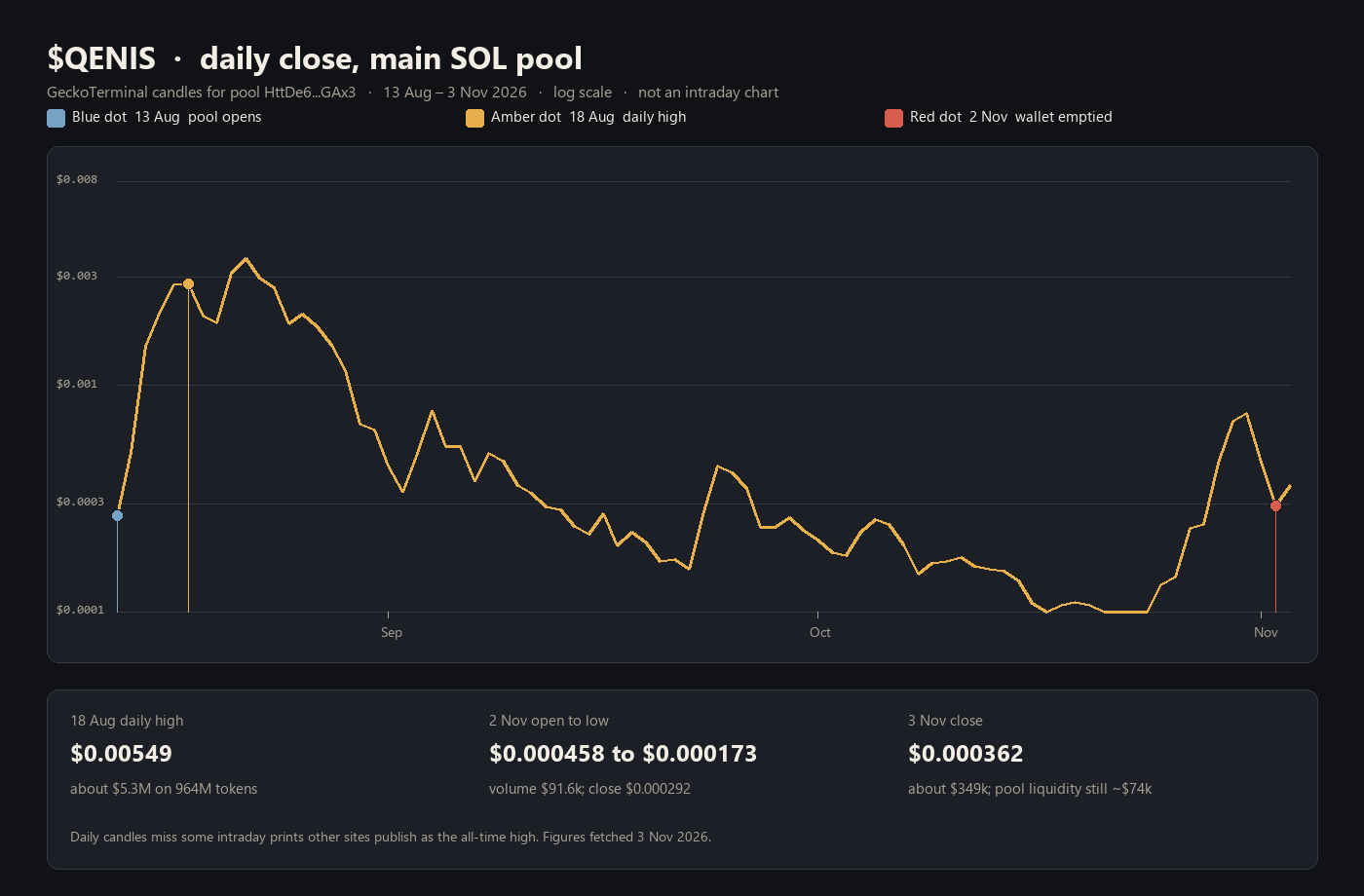
- 18 August: by 6:06 a.m. Central time the whole coin was valued at about $3.2 million. The day’s highest price briefly put it near $5.3 million. Later that day he locked another 20.8 million tokens for a year and said he would re-lock the first batch when its lock ran out.
- Safety switches: the coin was set up so that nobody can print new tokens or freeze anyone’s holdings. That’s good, but it says nothing about who holds the early supply.
After that first week, the price slid for more than two months.
Who actually speaks for the project?
Lots of accounts use the Qenis name. In this article, an account counts as official only if the website or the official YouTube channel points to it and it points back. A badge on a price-tracking site doesn’t count.
Official
- The website, qenis.io, lists two people. Qzoomer is the creator, and the site shows his wallet. Golem (@egoprry) built the website and is handling merchandise, which is still “coming soon.” The site says plainly that the coin is not an investment and promises nothing.
- The YouTube channel @OfficialQenis confirms the website and the coin address, names @TheQenis as the official X account, and warns about impersonators.
- @TheQenis on X says it was created by Qzoomer.
Claims to be official, but isn’t listed
- @wunno10 is a new X account, created 20 October 2026, with the bio “Qenis creator.” It’s the account that explained the hack. It presents itself as a temporary stand-in while Qzoomer gets his main X account back, and fans treat the two as the same person. The website doesn’t list it, and nothing technical links the two accounts.
- @OfficialQenis on X is easy to confuse with the YouTube channel because it uses the same name. But the YouTube channel points to @TheQenis, not to this account. It has talked about “my qenis holdings.” It’s friendly to the project but not confirmed as official.
Fans and promoters
- @Super_Bob0320 won second place (8 SOL, Solana’s main currency) in the first video contest and hosted a live audio chat about the character’s origins with Qzoomer.
- @TexomaGroyper posted a list of links and describes a “Council of Qenis” in his bio.
Both help spread the word. Neither controls anything.
One more thing that sounds bigger than it is: on 16 August, the coin’s page on DexScreener, a popular price-tracking site, was marked as a “community takeover.” That meant a fan took over editing the page’s social media links. It didn’t hand anyone control of the coin or its money.
The creator’s story
At about midnight Central time on 2 November, @wunno10 posted a long explanation. He said he was exhausted, searched Google for Pump.fun (the site where coins like this are launched), and clicked a paid ad at the top of the results. It led to a convincing fake. The fake site asked his wallet app to approve something. He thought he was just logging in, so he approved it. Soon after, he wrote: “Also I’m a [expletive] idiot.”
He said the scammer then moved all of his unlocked $QENIS and sold it. Within the hour he added numbers: he had spent about $40,000 buying the coin over time, most of it locked, and about $14,000 worth was taken. Those were the tokens he had set aside to give away as contest prizes.
Then the story about the locked tokens changed. In the first post he said he had about 200 million tokens locked and that the scammer “may have compromised” the wallet that will receive them when they unlock. He said the team was working to redirect them. About an hour later he posted: “My wallet was not compromised. The 200 million locked Qenis tokens are safe.”
Both statements can’t be the full truth. Think of a lock as a time-locked safe-deposit box. Nobody can open it early, and Streamflow, the service that runs these vaults, says so in its own documentation. But when the date comes, the box opens for whoever holds the key. If the key was stolen, the vault only delays the theft.
He also insisted this wasn’t a sell-off or an exit. He said he and “the core team” were taking back control of the coin’s pages and moving funds into new shared wallets that need several people to approve any transfer. As of 3 November, none of that had been publicly shown. It was announced, not done.
Two camps
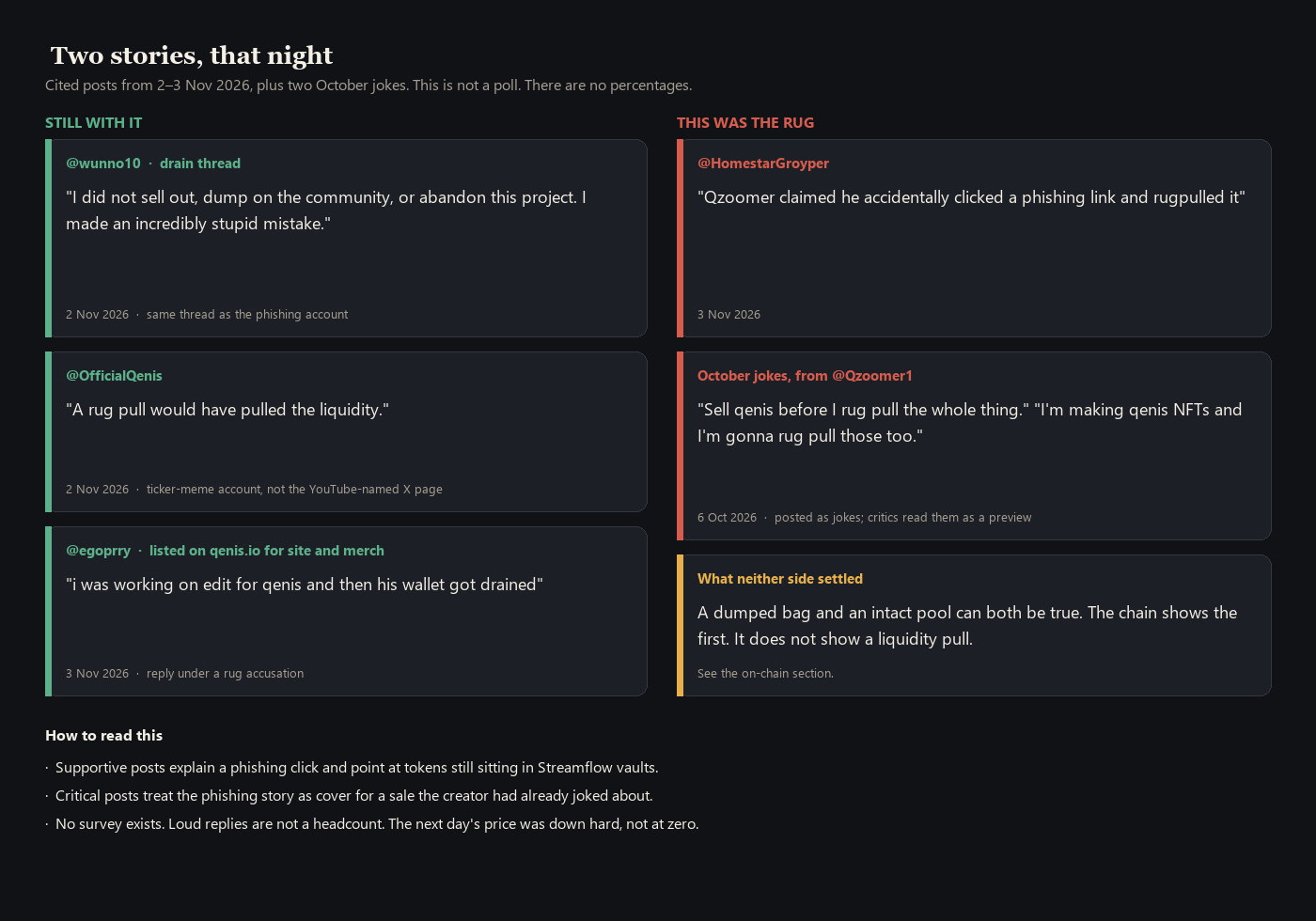
Supporters see a tired mistake and a project bigger than one wallet. @OfficialQenis answered a rug-pull accusation with one line: “A rug pull would have pulled the liquidity.” In other words, a real rug pull drains the trading pool, and that didn’t happen. @egoprry, the website builder, replied to a critic: “i was working on edit for qenis and then his wallet got drained.”
Skeptics think the phishing story is a cover. @HomestarGroyper wrote on 3 November: “Qzoomer claimed he accidentally clicked a phishing link and rugpulled it.” They point to two posts Qzoomer made on 6 October. One said: “Sell qenis before I rug pull the whole thing. I’m rugging it and taking all the money back to Israel.” Later that day he wrote: “I’m making qenis NFTs and I’m gonna rug pull those too.” Fans read them as jokes at the time. Since 2 November, critics read them as a warning. A joke isn’t proof of anything, but it’s harder to brush off once the money actually moves.
Nobody has surveyed holders, and loud replies aren’t a headcount. What can be checked is the price history and the wallets.
What the public record shows
Every transaction on Solana is public, so some of this can be checked directly.
The wallet was emptied in one move. At 9:50 p.m. Central time on 1 November, about two hours before the explanation was posted, the wallet on the official website sent out all of its $QENIS: about 26.3 million tokens. They went to two brand-new wallets, about 19.7 million to one and 6.6 million to the other.
Those new wallets were empty by 3 November. That fits the tokens being sold, though they could also have been passed on to other wallets.
The creator’s wallet then got tokens back. By 3 November it held about 6.7 million $QENIS again. These weren’t leftovers, because the wallet had been emptied completely. They were sent back or bought back afterward, and this check didn’t trace where they came from.
The $14,000 figure is close but not confirmed. At the 2 November daily open, 26.3 million tokens were worth about $12,000. At that day’s lowest price they were worth about $4,500. His “about $14,000” is a bit more than the tokens were worth even at the start of that day. It would match prices from a day or two earlier. It’s his estimate, not a confirmed sale total.
The price took a hit but didn’t die. On 2 November the price fell from $0.000458 to as low as $0.000173, a drop of more than 60 percent at its worst, before closing at $0.000292. By the next day it had recovered to $0.000362, putting the whole coin at about $349,000. That’s still about 93 percent below the August high.
The trading pool survived. About $74,000 was still in the main trading pool on 3 November. A popular coin-safety site flagged no risks and didn’t mark the coin as a rug pull. So the classic rug pull, where the pool is drained and nobody can sell, didn’t happen. That doesn’t make this harmless. Twenty-six million tokens leaving the creator’s wallet and being sold hurts every other holder the same way a dump does, whoever pressed the button.
The locked tokens are real, but there are fewer than claimed. The safety site shows six vaults:
| Vault | Tokens | How it compares |
|---|---|---|
| First lock (announced 14 August) | 99.2 million | Close to the 99.5 million announced, but not exact |
| Second lock (18 August) | 20.8 million | Matches the announcement exactly |
| Four smaller vaults | about 10 million each, 40 million total | Never announced one by one |
| Total | about 160 million |
He claimed 200 million: 120 million locked for a year, plus 80 million that unlock when the coin reaches certain value targets. The first two vaults add up to about 120 million, although the first batch wasn’t originally locked for a full year. He said he would re-lock it when it expired. The four smaller vaults could be part of the 80 million, but that still leaves about 40 million that don’t appear in any vault this check could find. The unlock dates, and who receives the tokens, couldn’t be read from public data on 3 November.
Treat the holder count with caution. One site reports 17,409 holders. Others showed about 3,500 the same week. The gap probably comes from wallets holding tiny leftover scraps, so the bigger number overstates how many people actually care.
What to watch next
1. The unlock. About 160 million tokens sit in vaults and can’t come out early. When they open, everything depends on who receives them. The creator has said both that the key may have been stolen and that it’s safe. Until someone publishes a change of recipient that anyone can check, holders are relying on his word, and he has already contradicted himself once. The amount matters too. At today’s price, 120 million tokens would be worth about $43,000, which is more than half of everything in the main trading pool. Selling that much at once would crush the price unless a lot of new buyers showed up.
2. The promised handover. He promised new shared wallets and control of the coin’s pages. Check the official website and the DexScreener page, not the replies. A new profile bio proves nothing. The August “takeover” only changed some links, and this one isn’t done until the people in charge are publicly named.
3. Whether anyone keeps making Qenis. In the first week, the only thing that set this coin apart from the copycats was that the artist kept posting and fans kept drawing. The website’s merchandise is still “coming soon.” @wunno10 links an online shop, but this article couldn’t confirm it has anything in stock. By his own account, the stolen tokens were the ones meant for future contest prizes. If the contests and the art stop, all that’s left is a price chart and a lock schedule.
Price figures are daily data from GeckoTerminal for the main $QENIS trading pool, collected 3 November 2026. Daily figures can miss brief price spikes. Wallet balances were read from the Solana network the same day. Times are Central time (New Orleans). This is not financial, legal, or tax advice.
Sources
- Onchain Circus, “Qenis: first five days” — onchaincircus.com
- qenis.io, official website — qenis.io
- YouTube, @OfficialQenis — youtube.com/@officialqenis
- @wunno10, drain thread, 2 Nov — x.com
- @wunno10, $40k / $14k post, 2 Nov — x.com
- @wunno10, “locked tokens are safe,” 2 Nov — x.com
- @wunno10, “main twitter” post, 2 Nov — x.com
- @OfficialQenis (X), liquidity reply, 2 Nov — x.com
- @HomestarGroyper, rug claim, 3 Nov — x.com
- @egoprry, reply, 3 Nov — x.com
- @Qzoomer1, second lock, 18 Aug — x.com
- @Qzoomer1, rug-pull joke, 6 Oct — x.com
- @Qzoomer1, NFT joke, 6 Oct — x.com
- @TheQenis, contest results, 24 Aug — x.com
- GeckoTerminal, main trading pool — geckoterminal.com
- RugCheck report — rugcheck.xyz
- Solana Explorer, the 2 Nov transaction — explorer.solana.com
- @AurafulAF, repost linking @Qzoomer1 and @wunno10, 2 Nov — x.com
- LoreScreener, Qenis entry — lorescreener.com
- @Super_Bob0320, audio chat announcement, 23 Aug — x.com
- @wunno10, “connect, not approve” post, 2 Nov — x.com
- @wunno10 profile — x.com/wunno10
- @TheQenis profile — x.com/TheQenis
- Streamflow, token lock documentation — docs.streamflow.finance